Warp-Level Culling for Efficient Blending in 3D Gaussian Splatting
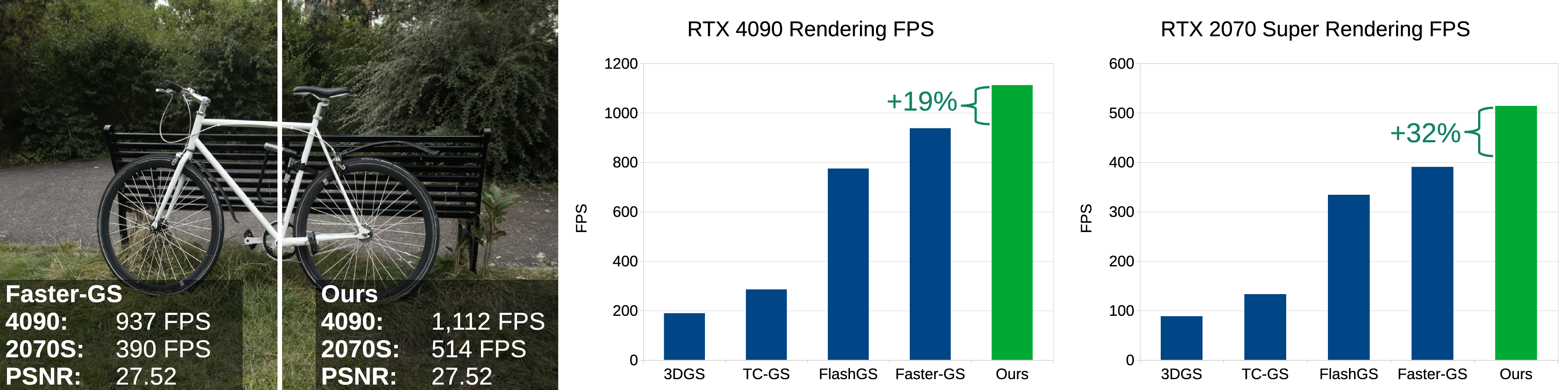
3DGS rendering FPS comparison across several methods demonstrating that, compared to Faster-GS, our method is up to 19% faster on the RTX 4090 and 32% faster on the 2070 Super while producing the exact same image.
Abstract
3D Gaussian Splatting (3DGS) is the de facto standard for capturing and rendering radiance fields in real time and has seen widespread adoption across a wide range of applications. Several recent methods have been proposed for improving rendering speed; however, these solutions often reduce model resolution, rely on approximations that degrade image quality, or require special hardware. We carefully analyze the performance of the standard CUDA-based pipeline used for rendering, focusing on overall memory transfer, synchronization bottlenecks, and computation load. Based on this analysis, we present three optimizations to 3DGS’s alpha blending stage that improve rendering performance without changing the rendered output. First, we use warp-level collaboration to subdivide an image tile and efficiently cull splats that have no geometric overlap with pixels, avoiding expensive alpha evaluation. Second, we choose render batch sizes that better optimize compute and memory load in the kernel. And third, we rearrange splatting data to make it easier to move through shared memory. Our algorithm modifications can be directly applied to the standard CUDA-based pipeline, making it easy to add to future implementations. We evaluate our method against other modern implementations to illustrate the computation gains achieved by our contributions.
See the implementation in our fork of Faster-GS.
Contact
Kenneth J. Yang: kjy5@uw.edu
Paper corrections
- Table 5 duration units should be microseconds.
HPG 2026 talk slides
ACM Reference
Kenneth Yang, George Drettakis, and Gilbert Bernstein. 2026. Warp-Level Culling for Efficient Blending in 3D Gaussian Splatting. Proc. ACM Comput. Graph. Interact. Tech. 9, 4, Article 54 (July 2026), 14 pages. https://doi.org/10.1145/3820019